By now, if you have any interest in video games whatsoever you’ve probably seen the pictures. They’re all over the web.
Finally, after a wait of almost a year, Nintendo have delivered the first glimpses at what, exactly the big surprise is with the control method of their new console – codenamed the Revolution. But let’s start at the beginning, shall we? At the very least, the name Revolution seems like quite the boast.
Actually, it’s pretty simple according to Jim Merrick; the senior director of European marketing for Nintendo broke it down like this in an interview with Edge magazine late last year:
“Historically, we’ve gone from revolution to evolution. NES was a revolution, SNES was an evolution; Nintendo 64 revolution, GameCube evolution, hence ‘Revolution is coming’.”
It would be so easy to put this down to marketing speak, but Merrick isn’t exaggerating. The Nintendo Entertainment System, when first released in the US in 1985 revitalised a home market that had stagnated under the reign of Atari. The console, known as the Famicon in Japan , introduced the D-pad, which has been used, in form or another, by almost every first-party controller since. It went on to sell 62 million units. Released in Japan in 1990, the Super Nintendo Entertainment System – or Super Famicon – introduced shoulder buttons on controllers, but the games were simply a case of bigger, better, more in comparison to the NES games. Nonetheless, it went on to sell 48 million units.
In 1996 came the Nintendo 64, which gave us the analogue stick, the controller rumble feature and brought 3D gaming to the mainstream. But the 30 million units sold were a sign of a decline brought about from a combination of problems including, but not limited to, a lack of support from third-party publishers, a belief that the console was a ‘kiddy’ machine and an eventual loss of sales to the more ‘adult’ Sony PlayStation.
2001 saw Nintendo release the GameCube, a console which, for the most part, failed to address the problems associated with the N64; in particular, it failed to shake the ‘kiddy’ image. It also failed to address the problem of third-party support – an issue that Merrick insisted Nintendo were “working very hard across the world” to improve, but admitted “it’s an ongoing challenge for us”. In Australia , the GameCube has only barely broken the 100,000 unit barrier. In comparison, the PlayStation2 has sold over 1,000,000 units – that’s one PS2 for every 20 Australians. Worldwide, Sony have broken the 100m mark.
There’s no question, then, that Nintendo are in a position now where a new machine must genuinely offer the public a new way of viewing the company, at the very least. That’s not to say that Nintendo are in financial peril or in danger of going the way of Sega and Atari and becoming a third-party publisher – Nintendo are still second in the worldwide console hardware market by a comfortable margin over Microsoft’s Xbox, and currently lead the worldwide handheld market. The Nintendo DS, released late 2004, is the fastest selling console in European history and received over 3 million pre-orders worldwide.
Perhaps more notably, while Sony and Microsoft continue to lose money with every console sold (estimates suggest that Microsoft has lost around US$2b from the Xbox) Nintendo profit from every GameCube sold. In fact, the company has not posted a loss since 1994.
So reports of Nintendo’s demise are far from true, but the company is still a long way from their 90% market share of the North American market in the 8-bit era of the late 80s and early 90s.
“ The only chance we have is to grow the market; to find more consumers and get them into videogames. What we see in Japan is that the market is stagnant; it doesn’t grow very easily. Japan ’s market is even declining now. Europe is the only market which is quite healthy right now,” commented Nintendo’s head of European Developer Business Marko Hein in an interview with www.GamesIndutry.biz just after the release of the Revolution controller specifications. “So what we as Nintendo believe is that we need to look for different user groups to get into videogames.”
This is not simply an attempt to gain an increased market share though – Hein cites the increasing development costs for next generation consoles (like the PlayStation3, Xbox 360 and the Revolution) as an influence on Nintendo’s position. On average, games for 16-bit systems cost US$10,000 to $15,000 to produce; by the time the PS2, Xbox and GameCube had emerged costs were beginning at US$1,000,000. Julian Eggebrecht of development house Factor 5, in a speech at the German Games Developer Conference suggests that next generation games are currently pitched at €10,000,000, but could go as high as €25,000,000. Although game manufacturing costs have come down since the time of cartridge based systems like the SNES (for which games would often retail for up to A$130) it’s pretty obvious that if development costs are rising by up to 1500 times what they were just 10 or 12 years ago, something has to give or prices will rise dramatically.
The fact is the industry has not grown dramatically in that time. Hein’s claims that the Japanese market – traditionally, the focal point of the industry since the crash of the North American market reigned by Atari in 1983 – is stagnating should come as a warning, although the gaming itself is by no means under threat of another crash given that the industry is currently a bigger money maker than the movie trade. But if the market cannot sustain the peak it has apparently hit in the current environment, then what chance does it have if the cost of software is raised to 1995 levels, or even above those?
More to the point, what chance do small developers and those who are attempting something different have in an environment where profit is everything? In an industry where the 10 top selling games in the US for the past two years have been either movie licences or franchise sequels (the top seller in 2003 was Madden NFL 2004 for the PS2; in 2004 it was Grand Theft Auto: San Andreas, again for the PS2), the incentive to try something different is just not there for those who do not have the cash flow to back it. Nintendo have been one of the few companies out there trying something different in recent years – along with Sony, Sega and Capcom, amongst too few other companies. Sony’s moves into innovation have moved toward netting exactly the results Hein speaks of – the EyeToy and the SingStar series have brought people to gaming who would not normally be interested. Nintendo’s DS has achieved the same results with its touch screen and voice recognition. Both companies have been fast to praise the innovative products that the other offer; “ I have to give credit to Sony,” commented Hein. “Because what they’ve done with EyeToy and with SingStar has also opened up a different experience and new set of consumers. Microsoft I’m not so sure about right now, because they are traditionally very focused on the hardcore gamers.”
But then, how easy is it to target an audience you’ve already got enraptured? How easy is it to target an audience who will buy your console based simply on the fact that it features a better chipset? In a comparison of the next generation of consoles for www.PrimoTechnolgy.com Gino Pellicano writes that “ procedural synthesis will allow the [Xbox] 360 to generate tessellation data in real time ” and that the PS3’s “ total floating point system performance will reach 2 teraflops, double what is expected from the Xbox 360”. Yet graphical performance cannot sustain a marketplace. Stifled innovation and creativity from the high costs and risks involved with the development of these games will not widen the market. And the fact is, for this next generation there will not be the jump in graphical quality that we saw between the 8-bit and 16-bit consoles, or between the PlayStation and the PlayStation2.
Undoubtedly, there will be a higher polygon count, and smoother animation, and better light and shade, but these will only serve to drive up development costs. Developer Treasure’s CEO Masato Maegawa addressed another concern in a recent Edge interview:
“Manufacturers want to differentiate their machines with concepts but, to be honest, inside the box it is almost the same. These are PCs which are only different because of their respective CPU [Central Processing Unit] and GPU [Graphical Processing Unit].”
It’s worth noting that this interview was conducted prior to the release of the Revolution controller design, but to reiterate: something has to give. Three consoles with essentially the same specifications, game publishers unwilling to try different things in lieu of just sticking with franchises, a market where the costs of development – even with hardware – is becoming vastly unbalanced with the actual sales costs? It can’t continue without the injection of new audiences, but the climate is not at all welcoming to prospective customers at this point. This is not to suggest that what Sony and Microsoft are doing with the PlayStation3 and Xbox 360 is wrong, or that it is bad business practice, or that they are in any way lesser consoles than the Revolution – both are more powerful from a technical standpoint – or that they belong in the marketplace any less than Nintendo do, but that the current target audience of these consoles is too narrow to foster effective market growth.
Jim Merrick described the Nintendo’s desired user groups as “the expanding audience, new consumers or people who used to play games but have since quit” in a post Revolution controller interview with www.Eurogamer.net . Thus the Revolution, a machine that truly attempts to reach a new audience by drastically departing from the accepted norm of controller design of the past 20 years by simplifying it.
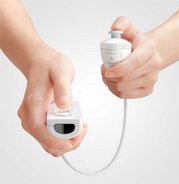
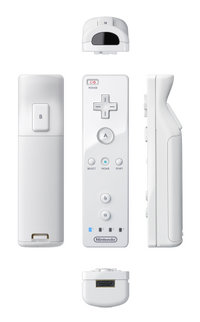
The controller is shaped like a remote control and has a digital D-pad at the top. Directly below this is the A button; on the underside of the unit is the B button – this is a trigger style button as first found on the Nintendo 64. Below the A button are the Start, Select buttons, accompanied by a Home button. Near the bottom of the unit are two additional buttons labeled a and b. The controller uses two Bluetooth sensors placed near the TV screen to operate in 3 dimensional space. Nintendo Power writer Steve Thomason summed up the controller:
“The basic unit…features what [Nintendo President Satoru] Iwata called a ‘direct-pointing device’, a sensor at the top of the controller that tracks its position and orientation. In other words, you can manipulate the action on screen by physically moving the controller.”
The sensors recognize not only left and right, and up and down, but also pitch and yaw. “We’ve talked a lot about expanding the population and breaking down barriers, and the new freehand-style controller, as we’re calling it, is very much a part of that,” Commented Jim Merrick. “This controller is just so intuitive - I hate using that term, but it really is!”
In addition, the controller features an expansion port on the bottom for what Iwata says will be a bundled-in analog stick, with two trigger style buttons named Z1 and Z2. This will be plugged in via a short cord in what Iwata has dubbed the “nunchuk” style configuration. The expansion port can also be used to slot the controller into a more conventional controller shaped “shell” (although it can also be turned on its side to resemble a NES controller), or into dance mats, or bongos, or…
There’s more than that though – “Let’s just say we have more surprises in store,” says Merrick .
Sound confusing? Sound like a lot to take in? Imagine this from the perspective of Nintendo’s desired new consumers. This is going to be perhaps the biggest issue in the lead up to the Revolution’s release – a date for which is currently not set, although Merrick confirms that the console will be available in 2006 and popular estimates suggest that the console could be available sometime around the PlayStation3’s slated launch of March.
According to Iwata, “the feeling is so natural and real, as soon as players use the controller, their minds will spin with the possibilities of how this will change gaming as we know it today.” The challenge that Nintendo faces at this point is to convince non-gamers of this.
The console itself is certainly appealing to current gamers – not only is there the promise of an accurate and simple control method, or the expected low price, but also the backward compatibility of the unit, which is capable of reading GameCube discs in the same way that the PlayStation3 will be compatible with all PlayStation and PlayStation2 titles and the Xbox 360 will be compatible with “best selling” Xbox titles. There is also the ‘virtual console’ of past Nintendo produced titles from the Nintendo 64, SNES and NES which will be offered via a Nintendo download service. Sonic creator Yuki Naja recently commented in an interview with Famitsu that he hopes “Sega games will be playable as well” and Nintendo is reportedly in discussion with other publishers and developers to secure the rights to use their past titles in the service as well.
This is all well and good – it’s more than this, in fact, and the console is shaping up to be truly revolutionary in a number of ways – but it still remains to be seen whether Nintendo can capitalise on what appears to be an unprecedented opportunity to open up the market. “The Revolution has the potential to appeal to new groups of consumers we’ve previously been unable to reach. It also has appeal for hardcore gamers, and the ability to bring a lot of people back to gaming,” explains Merrick . It is for the good of the industry in general – and not just for their own financial good - it is important that Nintendo reach that potential.