Sometimes I like to think that I actually understand mathematical concepts. I am, for example, a bit of a fan of prime numbers, and pi. Also, I seem to run a website named Little Mathletics. This has lead to me randomly being asked for help with mathematics assignments on Skype on more than one occasion. Let me make this very clear: just because I like maths, doesn’t mean I’m any good at it.
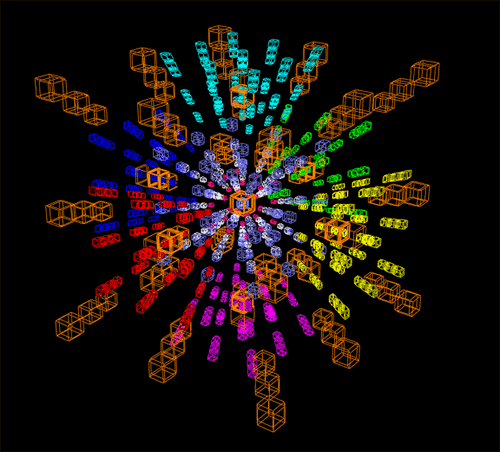
Here’s a great example that will prove my absolute incompetancy with all things mathematic: Charlie Nevill and Roice Nelson’s 5D Rubik’s cube game. I don’t understand how this works, to be honest. I mean, I don’t even understand how it is possible to have a 5 dimensional puzzle, but, here it is.
So, let’s start with the basics so we can all understand it, and so that kid who was doing semi-logerithmic studies (”so ur a wiz at maths?”) can realise that, dude, it’s not really my forte at all. A point is zero dimensional, that is, it has location, but no volume, area or length. A line is one dimensional, since it has length, and a square (or other shape with area) is two dimensional. 3 dimensional space is something with volume, eg. cubes, spheres, etc. 4 dimensional space is where things tend to get a little more freaky - this little fellow is a tesseract, or tetracube, or hypercube. The picture’s from Wikipedia, by the way.
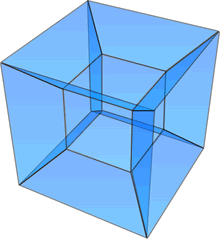
A hypercube - I think we’ll refer to it as that, because that’s a really excellent name - is the 4 dimensional equivalent of, as you may have guessed, a cube and is a regular polychoron. According to Wikipedia:
“A tesseract is bounded by eight hyperplanes [which, in this case is simply the dividing object - it’s also known as a “realm”] (xi = ±1). Each pair of non-parallel hyperplanes intersects to form 24 square faces in a tesseract. Three cubes and three squares intersect at each edge. There are four cubes, six squares, and four edges meeting at every vertex. All in all, it consists of 8 cubes, 24 squares, 32 edges, and 16 vertices.”
Basically, it’s bigger on the “inside” than the “outside”. I’m using quotation marks, because those terms really aren’t appropriate for this, since the shape above is not neccessarily a direct representation of the hypercube - it’s just one of many. Confused? Yeah, me too. Fortunately, Wikipedia offers up this gem:
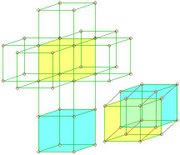
This is the net of the hypercube. Remember in school, making the cubes from paper using the cross shaped nets? Well, to make a hypercube, you’d need to have already made 8 cubes. And then you’d actually need to fold them into, and around, and through one another.
4 dimensional space is often referred to as time as well. This is where things get really confusing, because now we’re talking about a number of definitions for the same phrase. To go off on a slight tangent, if we assume that the 4th dimension is time, then Professor in Theoretical Physics from Utrecht University in The Netherlands Gerardus ‘t Hooft theorises that the 5th dimension is actually the spacetime fabric. I’m no Professor in theoritcal physics (certainly not one who won a Nobel prize for “for elucidating the quantum structure of electroweak interactions in physics” like Gerard, as he’s known to his friends) but that sounds very much like something you wouldn’t want to fuck about with and make a Rubik’s Cube from.
5 dimensional sapce is a theoretical construct, but is, according to Wikipedia, is a “perfectly legitimate construct”. It is not entirely certain whether or not our universe exists in five dimensions. What is certain is that this image attempts to explain what I’ve just written above, but actually just confuses me more.
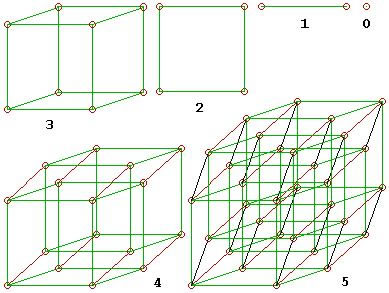
Number 4, you’ll no doubt recognise, is the hypercube. Freaky picture number 5 is what we’re talking about trying to solve a Rubik’s Cube made from. As the 5D Cube page says:
“Each of the d-dimensional cubies could be considered to have its faces covered by stickers of one smaller (d-1) dimension. But each cubie also only exposes a subset of its stickers to the “outside”, meaning these are the stickers you could see if you lived and operated in d dimensions. We can use the number of exposed stickers as a classification of cubie types. For the 3D case, the 27 cubies are broken into 4 types, those that expose 0 stickers, 1 sticker (”centers”), 2 stickers (”edges”), or 3 stickers (”corners”). In general, a d-dimensional cube will have d+1 of these types, those that expose 0,1,…,d different colored stickers.”
Which pretty much explains it, right? Basically, you’re trying to line up every thing “inside” and “outside” of the cube. Except, it’s not a cube. It’s a dotridecatetron. Or a decatetron, or maybe a hexatetron. I think. Anyway, the point is that you can now play it on your Windows PC, and can also attempt to be the fourth person in the world to finish it. I think we can pretty safely say it won’t be me, because it gives me a headache.
Props to Kotaku and Boing Boing for the heads up.
Man… That is incredibly awesome. Higher dimensional shapes blow my mind. Have you seen the klein bottle site run by an astrophysics professor from Berkely? You can buy klein bottle beanies! (or at least, klein bottle beanies embedded in 3 dimensions, which are still pretty cool).
Ah… It’s www.kleinbottle.com.