Cristopher Boyer Interview
Published by alistairw May 6th, 2006 in Interviews
Cristopher Boyer is the CEO of Variant Interactive, an independent developer and publisher based in Detroit who have recently made news on the games scene by picking up the rights to PC freeware title Doukustu Monogatari, better known to English audiences as Cave Story, a critically acclaimed action-adventure platform game. Gamer’s Quarter’s reviewer commented that the game reminded him of “why I play videogames in the first place”. In a time when the games industry is filled with clones, copies and ever extended franchises, it’s not hard to feel excited about what Variant and other independents are doing. Innovation is down, and the importance of profits is more noticeable to gamers than ever before. The ups and downs, successes and failures of any given title or console can be found on the majority of gaming websites. With independent companies like Garage Games taking Xbox Live Arcade by storm and attracting the attention of gamers, one gets the feeling that while the independent revolution of gaming may not be televised, but you’ll certainly read about it on Kotaku. Variant’s enthusiasm in particular is infectious. Their website states that their “mission and philosophy is simply to create the best environment for creative minds to produce the best games possible, upholding the simple truth that games, as art, can not be held hostage for outside concerns”. It’s hard to find fault with a company with a genuine passion for the industry it serves, and a site that shows its employees and management to be not only human, but also very funny.
Little Mathletics spoke to Cristopher via email about the upcoming E3, working as an indie in a big company’s industry, and why he does it.
What’s the history of Variant Interactive?
I’d love to say we sprang from the head of a Greek god, fully grown and ready to do battle. But then I’d be lying. (It was a Norse god.)
Actually, co-founder J.D. Laukkonen and I were in college, and we were talking about what we felt was the state of the games industry at the time. We both come from a writing background, and felt that with very few exceptions, the games coming out just weren’t hacking it on a quality level. So we originally decided to start a development company to create RPGs ala Final Fantasy and Wild ARMs. In part because that’d allow us to leverage our writing abilities better, but mostly because that happened to be our favorite genre at the time.
In doing research for our business plan and investor pitches, we came across all kinds of stories from development teams, especially small ones, who for lack of a better term, got hoed out by their publishers. Bilked out of royalties, robbed of intellectual property rights, bound by contracts of Herculean proportions, the list goes on and on. I’m sure you heard about the controversy that started with that “EA_Spouse” lady.
We decided that we didn’t want to be like that. We didn’t want those stories to become our stories. So around that time, we decided that if we became a publisher as well, to self-publish our games, we could sidestep the pitfalls of the traditional developer-publisher relationship. This idea evolved to “what if we offered OTHER developers the same benefits we’re trying to create for ourselves?”
So we wrote up the business plan, I started making the website (to this day I still maintain it, though the latest incarnation, I had a significant amount of help from one of our technical directors because my PHP sucks) and we started making the rounds with banks and investors, game developers and trade shows. This year is our 5 year anniversary of going to E3. Seems like only yesterday.
What’s happening for you guys at E3 this year?
Closed door stuff. Mostly we are meeting with developers who would like to work with us. We do things kinda weird - see, since we’re small we tend to only go to one show a year, and that’s E3. It’s free for industry personnel, unless you do the conferences (like I do) but even then it’s way less costly than Game Developers Conference — and for some reason it seems like we get more contacts leading up to E3 than GDC, so we go to that. Besides, it’s more fun.
I often wonder why GDC is so expensive. In fact, Jeff Tunnell from Garage Games was commenting on how “GDC is not worth it for Indie game developers” just a month ago.
Yeah, seriously. What is it, $2000 for the full pass? $5000? Honestly, that’s ridiculous. The full pass at E3 is around $500 and that’s far better, but sometimes I feel like even that is a lot.
Why do you think the industry needs independent publishers right now?
A good friend of mine is a screenwriter, and he recently sold an excellent script to a studio which I won’t name, and they greenlighted it and put it on the fast track to production. While on that track, they butchered his script, forced them to cast a bunch of less-talented television actors, changed the name and concept description to something that doesn’t even make sense, and just plain made a mess of things. Finally he and the production team got things close to where they could at least live with the changes, and the script resembling the original story, and they all relocated to Canada for filming. They got all the special effects shots and sets built and they were about to begin principal photography, when the studio decided that the executive assigned to the project wasn’t good at picking winners, and so they yanked all the funding. Just like that.
An independent fund has since come in and offered to foot the bill for the project, only on the condition that things go back to the way my friend originally wanted it, with the script revisions he wanted and the cast he wanted. It’s like an angel came out of nowhere with a multi-million dollar hook-up.
I feel the same way about what we are trying to do, to an extent. The bigger publishers are afraid to take risks. They bank almost solely on known quantities. That’s why you see a Madden 20XX every year. That’s why you see film adaptations of just about everything. That’s why you see games with sequels stretching into the double digits. And while that’s great, it’ll make you money, it won’t expand the industry.
In fact, I would dare say that it shrinks the industry, clustering it into a ball of fear. Watch next week’s E3 coverage. Count the sequels and film/book/TV adaptations. Compare them to new, original projects. See how many you count.
Why start an independent publisher in an industry that is very much ruled by established names?
When we first started out, we went to a conference on financing game projects, and during the Q&A session I asked Gene Mauro (now head of Myelin Media) how he’d finance a game publisher in our current economic climate. (Which, I think, has only gotten worse.) I’ll never forget what he said to me.
“Why would you want to?” he said. “EA’s pretty much got it all wrapped up.”
Since then, his old group CEG went under, and I don’t think I’ve heard of anything that’s come from Myelin. Meanwhile we are working on games aimed at the Xbox 360, PlayStation Portable, and others. It’s been a slow growth process, but it could be much worse. We might not be around at all.
Though, to answer his question and yours, to provide something new. People always seem to like ‘new’ things. As much as we all get in line for Final Fantasy XII and Halo 3 and God of War 2, we also talk ferverently about how great Katamari Damacy is, and how brilliant Psychonauts is, and how epic Shadow of the Colossus is. And for the most part, you aren’t going to get ‘new’ from the big names. Katamari was a throwaway project from Namco - they frequently talk about how they don’t get why it’s so popular. Psychonauts came from Majesco, which is not really a big publisher to begin with. Colossus is kind of the exception, but that’ll happen once in awhile, and we’re reminded of why it’s a good idea to take risks in the first place.
Of course, I’d love to have a franchise or three that ends up extending into the double digits, and on some level I look forward to getting creeped out by fanfiction that takes some incredible liberties with the characters, but that’s not something that’ll happen for awhile yet. No sense in looking TOO far ahead.
How have you gone about creating for the consoles you have, and is that difficult for an indie?
Well, first you must chop down the mightiest tree in the forest — with a herring. Then you must bring a second shrubbery, place it by the first to create a little path…
No, the thing is that there are a number of hoops that you have to jump through to become a licensed publisher with any of the big three. I’m learning very quickly what it means to have a “Pavlovian response.” Whenever I see “Microsoft” or “Sony” appear in my inbox I start to salivate. Or not, but you get the idea.
It IS hard to do as an independent. Though, mostly because we are new. They want to know “what games have you published?” So we respond with “PC Games. Because we’re new.” And then they’re like, “Oh, yeah yeah okay. So… what CONSOLE games have you published?” And so on.
I AM exaggerating a bit, and while that’s pretty clear I do want to point it out because the last time I said something jokey on these here Internets, our 3rd Party contact at Nintendo emailed me about it. So now I try to watch what I say a little more.
Anyway, once you’re clear with the hardware manufacturers on publishing/developing and they’re cool with whatever title you’re working on, you buy development kits and test kits and ramp up your staff and go to town. It’s a lot like PC development these days except there’s more red tape. I’m sure once we’re bigger than Electronic Arts it won’t be as much of a hassle. Or at least I’ll be paying people to navigate all that stuff for me, so at least it’ll be transparent for ME. And really, that’s what matters.
So you’re in contact with Nintendo? What’s happening there? Any plans?
Maybe. We’ll see.
How do you go about finding material to publish?
Sometimes we get a submission from a developer — which for legal reasons is pretty shaky. Like any other publisher, we do not accept unsolicited submissions because if we deny it due to grounds that we’re working on something similar, of course, we’re not always gonna say so, but they can claim we ripped them off. And that’s ugly. But sometimes they’ll do it right, and they’ll hint at a project or give us just a whiff of it, and it’ll be intriguing enough to look up and find out more about.
Sometimes, we (or I) will scour the depths of the Internet and find indie developers and contact them. They don’t always respond, for whatever reason. Not interested, prior deal, never heard of us, who knows. But the ones that do are super-cool and I’ve enjoyed working with. Hopefully in the next couple of months we can expand that elite group.
I assume that’s how you obtained the rights to Cave Story?
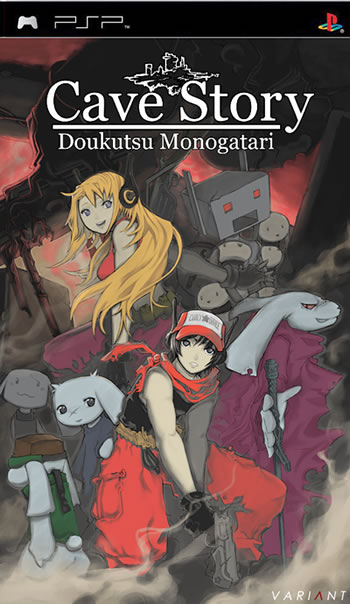
I contacted [developer] Pixel personally and worked things out with him. My Japanese is not that good though, and neither is his English, so after the first couple of emails he asked me to just write him in English, and he had Shih Tzu (who translated, among other things, Cave Story) translate for us. I think the current rigmarole that’s going on now resulted from the tenuous translations of our initial emails, when we tried to communicate on our own. It makes me wish I studied harder in college.
What’s the rigamarole?
Eh, there are some fans who think we’re trying to steal the game from Pixel, and thusly are going around to web forums and news sites claiming that we are “shady.” I think one person out and out called us crooks, and while I know it’s important to be impartial, this enterprise has kinda sorta been my life for the last five years, so it stings a little bit.
The thing is that some suspicious fans of the original game emailed Pixel using Babelfish to ask him about our adaptation, and when he said he didn’t know what they were talking about, they went all “AHA!” on us. The thing is that Babelfish does not translate grammar (or even correct words, many times) correctly - certainly English to Japanese does not work right when you are translating the grammar, and such messages would very much be hard to understand. And English with him is right out. So when he says “I don’t know anything about that,” it’s not that he’s never heard of us.
We’re working with him through Shih Tzu now to lay the matter out straight for everyone, because what these “fans” are doing really hurts the goodwill our company has in general, though I can understand where they’re coming from.
What changes have you made to the game?
We want to be as faithful as possible. We are upgrading the graphics and the sound to more “modern” levels, mostly for marketing concerns and platform requirements. I mean, I love the game as-is personally, I’ve played it obsessively since it came out, doing Hell speed runs with a keyboard and stuff, but I also want the game to reach a wide audience so more people can experience Pixel’s fantastic game — but the thing is that many people won’t touch a game that looks like it came out 15 years ago. And while there are folks like you and me who can appreciate the chiptune-like sound style, it’s not universal. If it was, I’m sure bands like 8Bit Weapon and stuff would be bigger, so we have to play to the masses. We do hope to include a retro mode that contains the whole game as-is though, so for those who are interested, they can rock out with it.
I know you probably get this one a lot, but what are the chances of seeing it on another system, like, say, the DS?
Ha ha. That is the big question, seems like. What’s everyone got against the PSP? I’ll start by saying that the PSP has a far more ideal aspect ratio for how the game was designed, and that is pretty good, and certainly UMDs are far larger than what we need. We’ll have to figure out a way to pack it with more cool things to make it worthwhile. There is a fellow working on a freeware port of the game to the Game Boy Advance, and I guess he’s making pretty great progress. As for our version on the DS, we need to be cleared through Nintendo first. We’ll likely know more about whether we are even clear to do it after E3 and the dust from Wii settles.
It’s an uphill battle on the DS for a number of reasons, but I won’t say it’s not impossible.
What about Mythos? How did all of that come about?
Mythos is what I am personally most excited about. Honestly this one is easy, it’s a property that J.D. Laukkonen and I created, back before Variant was birthed, we used to do a lot of writing and mucking around, and I started doing a webcomic. (He later did one using many of the same characters.) Anyway, it got to the point where I didn’t have time to do the webcomic, but liked the property so much that I wanted to see it migrate to a bigger platform and a wider audience.
It must be amazing to have the chance to work on your own IP.
It is pretty awesome. But you gotta fight for it more, and the other thing these days is that it’s so rare to come up with a wholly unique and original idea that nobody’s ever come up with. And about a year or two after the webcomic started, some other Japanese dude started a very similar comic which has met with significantly more success — perhaps because Shonen Jump was publishing his work, while my work was being published by myself in between college classes — either way, now it’s coming to the states in animated form and now it forces me, who got started first, to adapt. And it’s hard to have to make changes your baby.
What do you hope to achieve with Variant?
Same thing any business hopes to achieve. Success. Respect from our peers. A little critical acknowledgement/acclaim would be nice. Maybe a few big bags of money with a dollar sign painted on it. Y’know, stuff like that.
At first, I kind of hoped we could set an example for how to better run a game publishing company. We could show everybody that you don’t have to rob your developers and run them into the ground, and that you could make new and exciting original products without ruining your reputation or your bankroll. But then I realized if everybody started copying us, then we’d have a much bigger brawl on our hands, so I’ll be happy if everyone else keeps doing what they’re doing.
Which other indie publishers/developers do you admire?
Well, Kenta Cho, and Rake in Grass and Studio Pixel of course. Free Lunch Design makes some addicting little games, and I’m impressed with what DigiS is doing with Flash. Subtle Style is neat, and although I’ve never bought any of their games, I am eagerly anticipating what Telltale Games is gonna do with Sam & Max, but that’s because I loves me some Sam & Max. The Behemoth is doing awesome work, too, and I admire the tenacity with which they’re doing it. I had more fun with Insert Coin’s Rumble Box than is probably allowed, and I got a kick out of Introversion Software’s Darwinina too. I could go on all morning, but I’ll stop my yammering with my boys at Stardock, who are down the road from us and can hit me if I don’t give them a nod too. Seriously though, they are really doing well with what they’re doing, keeping within their means and still putting out a great product that rivals other AAA productions out there. We should be so lucky to do as well.
I must admit to not having heard of all of those (which is, of course, half the fun of asking you) but I am looking forward to the new Sam & Max. The webcomic that Telltale have up at the moment is fantastic.
Check ‘em out. There’s cool stuff out there. And yeah, I used to read Steve Purcell’s original Sam & Max comics when I was a kid. I used to go to the comic store with my cousin when he’d go to buy X-Men books, and I’d buy the one lone Sam & Max, and then go home to read and laugh til I cried. I still think I got the better end of the bargain.
Finally, with indie gaming and publishing seemingly on the rise again, do you see it changing things for the industry as a whole?
Maybe, but mostly at a big money level. Xbox Live Arcade is a big boon for the indie developer, but it still costs a good chunk of change to develop a game for it. And then you have like, Buena Vista Games publishing a new version of freeware game Every Extend — I think this will happen more and more, people are going to grab up my “cruise the global Internet for awesome games people are overlooking and bring them to a bigger audience for fun and profit” business model. And while I don’t mind terribly because it proves me right and I love being right, (heh) it also means that we gotta fight harder for our seat at the table.
I think it’ll still be only the heftiest indie developers who make a crack in the pavement of the industry, but maybe you’ll have groups like us to speak for them. Act as a loudspeaker for their message and their games, and one way or another, they’ll get out there.
Maybe once digital distribution becomes the norm and not the rule, we’ll see much more from indies in the mainstream. It removes one of the biggest barriers to accessibility that indies have, and that’ll be huge. It will be interesting to see!
You can find the Variant Interactive website here.