Archive Page 3

Cristopher Boyer is the CEO of Variant Interactive, an independent developer and publisher based in Detroit who have recently made news on the games scene by picking up the rights to PC freeware title Doukustu Monogatari, better known to English audiences as Cave Story, a critically acclaimed action-adventure platform game. Gamer’s Quarter’s reviewer commented that the game reminded him of “why I play videogames in the first place”. In a time when the games industry is filled with clones, copies and ever extended franchises, it’s not hard to feel excited about what Variant and other independents are doing. Innovation is down, and the importance of profits is more noticeable to gamers than ever before. The ups and downs, successes and failures of any given title or console can be found on the majority of gaming websites. With independent companies like Garage Games taking Xbox Live Arcade by storm and attracting the attention of gamers, one gets the feeling that while the independent revolution of gaming may not be televised, but you’ll certainly read about it on Kotaku. Variant’s enthusiasm in particular is infectious. Their website states that their “mission and philosophy is simply to create the best environment for creative minds to produce the best games possible, upholding the simple truth that games, as art, can not be held hostage for outside concerns”. It’s hard to find fault with a company with a genuine passion for the industry it serves, and a site that shows its employees and management to be not only human, but also very funny.
Little Mathletics spoke to Cristopher via email about the upcoming E3, working as an indie in a big company’s industry, and why he does it. Continue reading ‘Cristopher Boyer Interview’
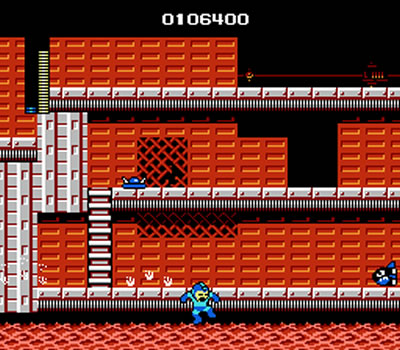
Speed runs - the act of getting through a game as quickly as possible - arguably date back to Gunpei Yokoi’s Metroid for the NES, back in 1986, which featured different endings based on the the time taken to finish it. While taking over 10 hours would show the main character, Samus Aran, with her back to the camera, apparently holding her hand up to her face in an expression of sadness, finishing the game in under one hour would show Samus in a bikini - albeit, an 8-bit one.
The first online speed running community was 1994, built around the Doom newsgroups and websites of the time. Later, the release of the Doom source code made it possible for players to slow the gameplay down, which lead to the branching off of the tool assisted speed run (or TAS) community.
With the popularity of emulators, tool assisted runs became possible on older consoles, eventually culminating in the release of Morimoto’s famous Super Mario Bros. 3 video, in which he finishes the game in 11 minutes and 11 seconds. However, the relative obscurity of the tool assisted scene lead to confusion about the video - was it real, or was it cheating?
Accusations of “fakeness” miss the point of the tool assisted scene. Even the idea of “cheating” misses the point. These speed runs are created for entertainment, for the sake of pushing the game to its very limits and seeing what can be achieved when the abilities of the player are enhanced. The runs are not achieved by cheating - the games are not hacked, and cheating is discouraged.
Joel Yliluoma, better known as Bisqwit, runs NESVideos, arguably the centrepiece of the TAS scene, and comments on the site that “instead of walking on the paths created for us, we create our own paths, our own legs and so on, and we’re not listening to people who say “you can’t do that!”.”
The result is often awe inspiring, and always entertaining, even for people not familiar with the game in question, because the runs are done with entertainment in mind. The guidelines on NESVideos suggest creating “art even while waiting”, and to “play for entertainment, not for ego”.
As for the Morimoto video, the time was beaten in 2005 by Genisto, who finished the game in 10:35.
Little Mathletics spoke to Joel via email about the site, the scene, and the criticism. Continue reading ‘Joel Yliluoma Interview’

Just to clear this up from the start, ABA Games is Kenta Cho - one man, working on games in his spare time. This, in itself is nothing new; there have been plenty of games made by one person - though not many of them have been this good.
Certainly not good enough to be called ” true artistry” by the Escapist, or the maker named “one of today’s best independent game programmers” by Macworld Magazine.
At its best, Kenta Cho’s work is another level above what is often put out by entire independent developers. For the most part, he’s focused on shoot ‘em ups - or “shmups” - a genre that started (arguably) with Space Invaders in 1978, and has evolved over the years through games like R-Type, Tempest, Xevious and Ikaruga. Cho’s work embraces the games that have shaped the genre, while adding to them and expanding upon them.
The controls of the games are rock solid, especially for those with USB gamepads, and the sounds and music are stunning. The graphics are often vector based (like those in Asteroids and Space Wars) but are detailed and beautifully animated - without exception. But perhaps the most striking thing about the games is the obvious amount of care and work put into them. That these games are not, for one, commercial releases, and secondly, not a full time project for Cho, is astounding. These games are amongst the best that the independent games scene has to offer.
Perhaps one of the reasons for this is that Cho doesn’t make these games for an audience. “I only created games that I want to play,” He says. “And shared them with people who want to play.”
These are games aimed at gamers - in this sense, they hark back to the independent scene of the 80s, when developers like Matthew Smith made games like Manic Miner and Jet Set Willy because that’s what they wanted to play. As we move into a time where game’s budgets are moving well into the tens of millions, it’s heartening to see this spirit hasn’t died out.
Little Mathletics spoke to Kenta Cho via email about the history of ABA Games, the inspirations behind his work, and what’s still to come. Continue reading ‘Kenta Cho Interview’

Beginning in 2001, GarageGames have aimed to bring games development back to the independents - or even the individuals. Founded by Jeff Tunnell, Rick Overman, Tim Gift and Mark Frohnmayer - all formerly of Dynamix, which was closed by Sierra during the restructuring of the company by Vivendi Universal.
GarageGames is there to take the focus of the industry away from the big publishers like EA, and inject creativity and freshness into a market that has become bogged down in sequels and licences.
The company’s website is not just a place for the companies products to be sold, but is a support network and research centre for developers, who can use the considerable expertise of those who work there.
The main product is the Torque Engine - a modified version of the engine used by Dynamix for Tribes 2. And immensley powerful piece of software, it is available to indie developers for US$100, and has recently been expanded to include the Torque Shader Engine, which allows support of higher level shading technology.
The Shader Engine was used to delevop Marble Blast Ultra, which was released onto Xbox 360’s Live arcade to enourmous success, effectively raising the bar of what was thought possible by an indie developer.
We spoke with Jay Moore, self described Evangelist, buzz builder, biz dev. guy, and game promoter from GarageGames. Continue reading ‘Jay Moore Interview’

The first issue of Bear hit the stands in June of 2003, and the tenth and final issue arrived in December, 2005. In between, Jamie Smart estimates that he worked on 300 pages - half of which were collected in 2004’s Bear: Immortal trade paperback, the other half of which will be collected in the upcoming Bear: Demons in June.
The comic is published by Slave Labor Graphics, an American “alternative” company, though Jamie himself is British.
Past articles on Little Mathletics would suggest that this is the point that I should start talking about how the work is an example of postmodern genius, but Wikipedia beat me to the punch:
“The stories are marked by a combination of violent shocks, random silliness , and other hallmarks of Dada.”
I could spend a while here arguing that it does not, in fact, show the hallmarks of Dada, but that would be missing the point of Bear. It’s short, sharp and hilariously funny, and for that reason, it appeals to a wider audience than a majority of comics. Storywise, Bear is simply the story of a stuffed bear, named Bear, his owner, Karl, and Looshkin, Karl’s cat, whose life’s work is to torment and maim Bear. There’s no story arcs, or alternate universes, just swearing and destruction. And faeces. It’s got something for everyone.
Little Mathletics spoke to Jamie Smart about Bear, his new projects, and much, more more. Continue reading ‘Jamie Smart Interview’

Given the current pre-occupation here at Little Mathletics with gaming as art (see our fur interview, and our 8-Bit Artist interview), it makes sense that her work would make its way onto the site sooner or later.
Her work from 2000, mario battle no. 1, is a hacked Super Mario Bros. ROM with all the level detail removed - “?” blocks, enemies, power ups, goals, etc. The result is, as Myfanwy puts it, is a game where:
“…there is nothing left to do but go for a walk, run, or jump around, solitary in the landscape and then you run out of time and die.”
The “game” that’s left is unexpectedly versatile - different players will react in different ways. The choice is there to wait, or to run, or try and find a goal, but the end result is always the same; it’s a brilliant example of the user defining notions of postmodernism - that is, no two users, or readers, or viewers, will react to the “text” in the same way.
Two more were later released - mario doing time and mario is drowning, both variations on the theme. Videos of the games were intended to be shown in Dundas Square in conjunction with the Controller exhibition at Interaccess Media Arts Centre in Toronto, until the advertising board’s owner, ClearChannel, threatening to pull the videos unless a release for the copyright material was granted by Nintendo. The work was replaced by Myfanwy’s gameover: zombienation v1.2 - a one minute video of the”Game Over” screen from the game Zombie Nation slowly fading to black.
During the course of her career as an artist, Myfanwy has been exhibited alongside artists like Yoko Ono, Sol LeWitt, Mark Hosler of negativland and has also short listed for the prestigious K.M. Hunter award in 2003.
Little Mathletics spoke to Myfanwy about her work, her views on games as art, and her history as a gamer.

Pop art, or Neo-Dada art, is a style that employs the use of populist, rather than high culture, elements. Depending on your view of these matters, it’s either an expansion of abstract expressionism, or a reaction to it.
Since early 2005, the 8-Bit Artist has been painting authentic renditions of Nintendo games from the 8-bit era - taking what is considered to be the lowest of all forms of artistic expression, and bringing the iconography of the medium to the canvas. In many ways, this goes beyond pop art even, and well into the realm of postmodernist art, at least in the definition of the form by Jean Baudrillard who wrote that art is not the search for originality or authenticity, but rather the desire for novelty - although, far from being a bad thing, Baudrillard explains that this is an integrated and organic phenomenon.
In this sense, and in the sense that postmodernist art is often a pastiche of what has come before, 8-Bit Artist’s work attempts to make sense of the confusion that exists in a generation who have grown up with this imagery, but have been told that this is not “true” art.
Film critic Roger Ebert recently commented that ” video games represent a loss of those precious hours we have available to make ourselves more cultured, civilized and empathetic”. The work of the 8-Bit Artist challenges this, though he may not see it that way himself:
“I just do this as a hobby and side gig,” he says. Little Mathletics spoke to 8-Bit Artist recently about games as art, and his work. Continue reading ‘8-Bit Artist Interview’
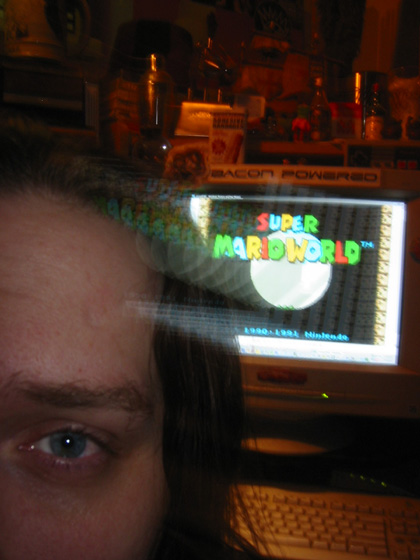
Jason Cox’s career as one-man-band Xoc hit the big time in August last year when his debut - SMW, a cover of the entire Super Mario World soundtrack done using accordion, acoustic guitars, antique pickaxe, asscheeks, banjo, bike horn, cabasa, Canon Powershot, ceramic toilet mug, children’s drum set, claves, coconut thumb piano, cowbells, cuatro, doublespeed acoustic guitar, doublespeed banjo, doublespeed guitars, drum set, drum sticks, electric bass guitar (Yamaha RBX200), electric guitars, finger cymbals, gooseneck mic stand, handclaps, handmade maracas, jam block, jew’s harp, Korg MS2000B synth, lap steel guitar, maracas, matchbook, melodion, ocarina, pennywhistle, pump organ, PSS-270 keyboard, refrigerator door, ribbon crasher, Roland Groovebox, rototom brace, school bell, shakers, slide whistle, sportshorn, tacklebox, tambourines, triangle, turkey locator, Tyco Hot Lixx, ukelele, upright bass, violin, vocals, woodblock, wood flute, Wurlitzer electric piano, and xylophone - appeared in Edge Magazine who said that “every track is both a pop gem and a testament to the lasting appeal of [Koji] Kondo’s compositions and XOC’s one-man-band prowess”.
8 months later, the album -available for free on the Internet Archive - has clocked up in excess of 82,000 downloads, which is more than 60,000 more than any other open source audio.
Jason’s next project as Xoc was Videogame: The Movie: The Game: The Cover Album, an double album of covers and originals from a supposed pirate NES game, which, in turn was based upon a supposed movie from 1984 starring Jonathan Brandis, Jill Bennett and Ed Flanders. The concept features an 1,800 word summary, including the history of the movie, it’s producers, and reveals that “all three of the film’s stars would eventually go on to commit suicide”. It’s a mix of fact and fiction that goes into such depth it beggars the senses.
Again, Xoc was featured by Edge, this time on their website, where they called this work a ” twisted conceptual madness”, and Xoc’s “magnum opus”.
Over the period of just over a month, Little Mathletics spoke to Jason about SMW, Videogame: The Movie: The Game: The Cover Album and a myriad of other topics, all through the magic of email. Continue reading ‘Xoc Interview’
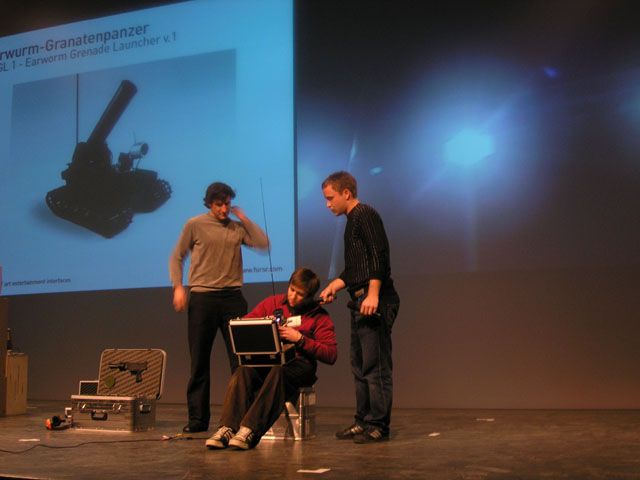
Since meeting at the Academy of Media Arts in Cologne in the late 90s media artists Roman Kirschner, Volker Morawe and Tilman Rieff have been working together under the name fur, a group that, in their own words “stands for the re-staging of computer-entertainment based on multisensory interfaces” - or, in other words, work to decontextualise videogames and other forms of computer based amusements by changing the way they are used.
By changing the interfaces used to interact, the creations of fur go beyond “visual navigation, manual control and massive single-user isolation” to become something completely new, not only within the world of videogames, but also within the world of art. Their most famous work is the PainStation, from 2001- a game of Pong within a specially designed cabinet that would whip and shock players hands, often causing tangible wounds, which fur describe as a ” a contemporary dueling system”.
The team won an International Media Art Award for the machine in 2003, the same year in which the machine was superseded by the PainStation 2, and that by the PainStation 2.5 in 2004. Since then, the six PainStation machines have been touring the world, displayed at exhibitions from London to Mexico City and just about everywhere in between.
Reaction to the machine on the PainStation website’s guestbook is varied, ranging from the good:
“Greatest gaming console the world has ever known. Me and two of my friends visited London last summer after our graduation. We ended up going to the V&A’s TOUCH exibit where we thankfully found the original PainStation. We couldn’t or at least I couldn’t get enough of plaing the game, I believed that I stood there playing various spectators for over two hours.”
To the bad:
“This is so DUMB… are people so bored that they want to get themselves hurt??? Then again, there are movies of dudes hitting eachother with things for FUN so i’m not that surprised people would also find this Painstation thing cool.”
And the ugly:
“Fuck off you stupid wankers, fucking sadomastic pricks, go strangle yourself with barbewire or something.”
Little Mathletics recently spoke briefly to Tilman Rieff about the PainStation, the notions of games as art, and their plans for world domination… Continue reading ‘fur Interview’

This piece was originally published in zine form as “Fred Basset: A Postmodernist Reading of the Work of Alex Graham” for the 2006 Adelaide Fringe Festival Zine Fair. Since then, mostly nothing has been changed, which might lead some purchasers of said zine to feel somewhat cheated out of their 20 cents. Continue reading ‘Fred Basset’
